'%3e%3cpath%20d='M10%2020C7.34784%2020%204.8043%2018.9464%202.92893%2017.0711C1.05357%2015.1957%200%2012.6522%200%2010C0%207.34784%201.05357%204.8043%202.92893%202.92893C4.8043%201.05357%207.34784%200%2010%200C12.6522%200%2015.1957%201.05357%2017.0711%202.92893C18.9464%204.8043%2020%207.34784%2020%2010C20%2012.6522%2018.9464%2015.1957%2017.0711%2017.0711C15.1957%2018.9464%2012.6522%2020%2010%2020ZM10%2018C12.1217%2018%2014.1566%2017.1571%2015.6569%2015.6569C17.1571%2014.1566%2018%2012.1217%2018%2010C18%207.87827%2017.1571%205.84344%2015.6569%204.34315C14.1566%202.84285%2012.1217%202%2010%202C7.87827%202%205.84344%202.84285%204.34315%204.34315C2.84285%205.84344%202%207.87827%202%2010C2%2012.1217%202.84285%2014.1566%204.34315%2015.6569C5.84344%2017.1571%207.87827%2018%2010%2018ZM9%2010.41V4H11V9.59L14.95%2013.54L13.54%2014.95L9%2010.41Z'%20fill='%23616F96'/%3e%3c/g%3e%3cdefs%3e%3cclipPath%20id='clip0_3717_10620'%3e%3crect%20width='20'%20height='20'%20fill='white'/%3e%3c/clipPath%3e%3c/defs%3e%3c/svg%3e) 7 min.
7 min.
What to Choose: Bank Cards or Electronic Payment Systems
Added: June 11, 2026
Updated: June 25, 2026
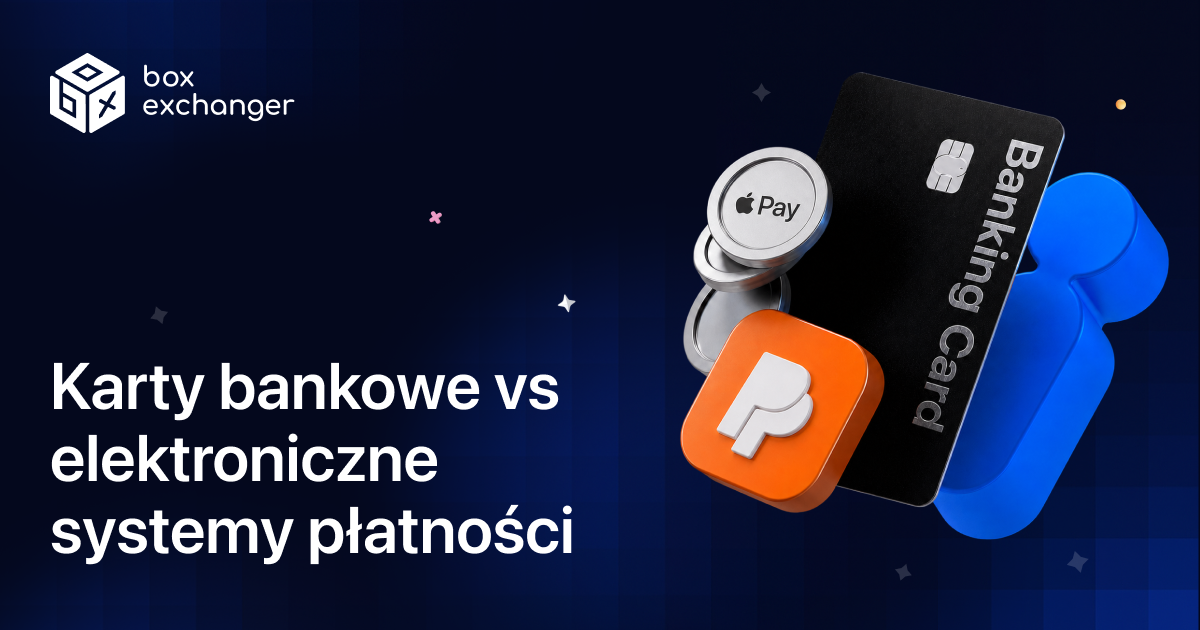
What is better to choose — a bank card or electronic payment systems? There is no single correct answer. “Bank cards versus electronic payment systems” is a false dilemma: both tools often work together. The difference lies in what each of them does best.
How Bank Cards and Electronic Payment Systems Differ
Comparing a bank card and an electronic payment system means comparing different layers of the same financial ecosystem. A card is linked to a bank account, and transactions are processed through Visa/Mastercard and the issuing bank. PayPal, Wise, Stripe, or a crypto wallet build their own payment rails: multiple funding sources, proprietary logic, often without relying on a single bank at the core. A card provides access to the global Visa/Mastercard network, while an electronic system offers flexibility through multiple currencies, API integrations, and its own loyalty ecosystems. According to data from Aevi, there are three payment channels: cards, bank transfers, and e-wallets, each serving a specific purpose. In China, Alipay and WeChat Pay dominate; in Europe, SEPA transfers are preferred; in the United States, cards and P2P payments are common. International businesses cannot rely on a single tool alone.
Advantages of Using Bank Cards for Online Payments
A bank card remains the most universal payment instrument for several reasons.
- Chargeback: the bank can reverse a disputed payment directly under Visa/Mastercard rules.
- Credit limit: spending before payday is a standard credit card feature.
- Universal acceptance: no additional registration is required, and it works immediately in most countries.
- Regulatory protection: banks operate under financial regulator oversight, providing real legal safeguards.
The main weakness is the same as with the broader banking sector: strict verification requirements, restrictions on certain payment categories (cryptocurrency, gambling, some jurisdictions), and a slow response when service conditions change.
What Capabilities Electronic Payment Systems Provide
Electronic systems excel where flexibility is required. According to Noda.live, digital wallets accounted for 53% of all global transactions in 2024, surpassing cards and bank transfers combined.
Key capabilities include:
- Registration without visiting a branch.
- Multiple currencies within a single account with automatic conversion.
- Built-in APIs for integration with online stores and marketplaces.
- The ability to hold both crypto and fiat funds within one interface.
This is why the payment infrastructure of modern online businesses is increasingly built around electronic systems rather than relying solely on traditional bank acquiring.
Transfer Speed and Fund Availability: What Is More Convenient for Users
An internal bank transfer can take hours; an international SWIFT transfer usually requires 1–5 business days and often longer due to correspondent banking chains. Electronic systems process transfers instantly. Ethereum confirms transactions in 12–15 seconds, while Solana is even faster. The difference is fundamental: funds are already available instead of “arriving on Friday.” SEPA Instant narrows the gap in Europe, but the option is not available everywhere.
Fees and Hidden Costs of Different Payment Methods
The cost difference is significant. According to the World Bank Remittance Prices Report for Q1 2025, banks remain the most expensive type of provider: the average cost of an international transfer of $200 is 14.55%. Digital-only operators charge 3.55%, nearly four times less.
Hidden card-related costs include currency conversion fees (1–3%), annual maintenance fees (up to $50), and international cash withdrawal charges. Electronic systems also have fees: Wise charges 0.35–2% for currency conversion, while PayPal charges up to 4–5% for international transfers funded by a credit card. The key difference is transparency: electronic system fees are visible before a payment is made, not after receiving a card statement. The actual transfer cost can be compared 30 seconds before sending rather than after the funds have been debited.
Security of Bank Cards and Electronic Wallets
Both tools are vulnerable, but in different ways. According to IBM Security (2024 report), the average cost of a data breach reached $4.88 million in 2024, up 10% year-over-year. In the financial sector, the figure is even higher: IBM reports $6.08 million per incident.
Cards are protected by chargeback mechanisms and 3D Secure. Electronic wallets offer two-factor authentication and biometrics, but disputing a transaction after account compromise is generally more difficult than resolving a card dispute through a bank. Total consumer losses from digital fraud in the United States exceeded $12.5 billion in 2024, a 25% increase year-over-year. The practical conclusion is that security depends less on the chosen tool and more on user behavior: unique passwords, 2FA, and transaction monitoring matter more than the payment method itself. An additional safeguard for cards is virtual card numbers that generate a one-time PAN for every online purchase. This significantly reduces risk if a merchant experiences a data breach.
Which Payment Methods Are Best for International Transfers
When it comes to cross-border transactions, the score clearly favors electronic solutions. SWIFT fees range from $25 to $80 per transaction, plus currency conversion at a bank’s internal exchange rate, which is typically less favorable than the market rate. Wise, Revolut, and similar services use the real mid-market rate and earn revenue only from conversion fees.
For recurring payments to freelancers, partners, or suppliers in another country, electronic systems provide substantial savings. Exchange services operating on the BoxExchanger platform solve a similar problem for cryptocurrencies: users receive funds in the desired network with minimal spread instead of paying standard banking fees.
What Is More Convenient for Working with Cryptocurrency
Bank cards provide fiat on-ramp and off-ramp services, but they are powerless within the blockchain itself. Electronic systems that support cryptocurrency (Coinbase, Trust Wallet, Binance crypto cards) allow users to store, send, and convert assets within a single interface.
According to the Chainalysis Global Crypto Adoption Index 2024, stablecoin transaction volume increased by 77% year-over-year. Eastern Europe ranks among the leaders in crypto volume relative to GDP, driven by banking restrictions and high levels of technical literacy among users.
Choosing a Payment Tool for Businesses and Online Stores
The debate between bank cards and electronic payment systems for businesses comes down to one question: how many markets do you serve? If you operate in a single market with a national currency, acquiring may be sufficient. If you serve multiple markets, you need a multi-currency account and several payment channels.
Payment solutions from companies such as Stripe and Adyen accept cards, wallets, transfers, and cryptocurrency through a single API. If customers cannot find their preferred payment method, they leave. Research shows that adding one additional local payment method can increase checkout conversion rates by 5–15%; for e-commerce businesses, this directly impacts revenue rather than simply improving user experience metrics.
Can Both Options Be Used Effectively at the Same Time?
Most users already do this, and it is a sensible approach. A typical setup looks like this:
- Primary card: for offline purchases and transactions where chargeback protection is important.
- Electronic wallet: for online transactions, international transfers, and storing multiple currencies.
- Crypto wallet: separate, for managing blockchain-based assets.
This approach minimizes risks: if a card is compromised, funds stored in a wallet remain unaffected. Separating tools by purpose also improves financial transparency, making it easier to track spending by category.
For businesses, this approach is especially valuable. Different payment channels can be assigned to different transaction types, simplifying accounting and reducing operational risks if one provider experiences an outage.
When Is It Better to Choose a Bank Card and When an Electronic Payment System?
Banks or payment systems: the right choice depends on the context. Here are practical criteria without unnecessary generalizations.
A bank card is preferable when:
- Paying in a physical store that does not support wallets.
- Chargeback protection is needed for a large purchase from an unfamiliar seller.
- A credit limit is required.
- Renting a car or checking into a hotel, where a card is required for a security deposit hold.
- An electronic payment system is preferable when:
- An international transfer is needed without several days of waiting and double-digit fees.
- Managing multiple currencies or cryptocurrencies simultaneously.
- API-based payment integration is required for an online store.
- Keeping multiple payment instruments within a single application is important.
Conclusion
A card and an electronic payment system do not compete with each other; they solve different problems. A card provides chargeback protection and access to credit, while an electronic system delivers speed, multi-currency functionality, and API connectivity. The smart strategy is not to “choose one” but to “assign tasks”: a card for secure offline payments, a wallet for international transfers and cryptocurrency, and an API provider for business payments. For payment service operators, the more important question is how flexible the underlying architecture is when serving customers through multiple channels simultaneously.
The information presented in this article is for informational purposes only and should not be considered a guide to action, financial recommendation, or investment advice. Investing in cryptocurrency involves a high level of risk, and every investor should conduct their own research, evaluate their financial situation, and consult professional financial advisors before making investment decisions.
Frequently Asked Questions
Is an electronic payment system safer than a bank card?
Neither tool is completely secure. Cards are protected by chargeback mechanisms and 3D Secure, while wallets rely on two-factor authentication and biometrics. The actual level of security depends on user behavior: a unique password, 2FA, and regular transaction monitoring are more important than the choice of payment method.
Can you work exclusively with electronic payment systems and completely abandon cards?
Theoretically, yes, but in practice it does not work everywhere. Car rentals, hotel deposits, and many B2B services specifically require a card. An electronic wallet without a linked card cannot fully replace it in these situations.
Why are banks more expensive for international transfers than electronic systems?
Banks operate through correspondent SWIFT networks involving multiple intermediaries, each charging a fee. Electronic systems such as Wise use internal P2P settlement mechanisms: funds do not actually cross borders but are redistributed between local balances. This reduces costs from 10–15% to 3–4%.
Also read
September 23, 2026
KYB in Cryptocurrency: What It Is and How Business Verification Works
Every bank, payment processor, and major exchange sooner or later asks a crypto service not for the director's pass...

September 18, 2026
Loyalty Programme for a Crypto Exchange: Mechanics and Benefits
Crypto exchanges compete almost exclusively on exchange rates and the speed of order processing, while the differen...
September 4, 2026
Anti-Fraud System for a Crypto Exchange: How It Works
In 2024, addresses flagged as illegal received $40.9 billion, whilst the amount of funds stolen from services rose ...