'%3e%3cpath%20d='M10%2020C7.34784%2020%204.8043%2018.9464%202.92893%2017.0711C1.05357%2015.1957%200%2012.6522%200%2010C0%207.34784%201.05357%204.8043%202.92893%202.92893C4.8043%201.05357%207.34784%200%2010%200C12.6522%200%2015.1957%201.05357%2017.0711%202.92893C18.9464%204.8043%2020%207.34784%2020%2010C20%2012.6522%2018.9464%2015.1957%2017.0711%2017.0711C15.1957%2018.9464%2012.6522%2020%2010%2020ZM10%2018C12.1217%2018%2014.1566%2017.1571%2015.6569%2015.6569C17.1571%2014.1566%2018%2012.1217%2018%2010C18%207.87827%2017.1571%205.84344%2015.6569%204.34315C14.1566%202.84285%2012.1217%202%2010%202C7.87827%202%205.84344%202.84285%204.34315%204.34315C2.84285%205.84344%202%207.87827%202%2010C2%2012.1217%202.84285%2014.1566%204.34315%2015.6569C5.84344%2017.1571%207.87827%2018%2010%2018ZM9%2010.41V4H11V9.59L14.95%2013.54L13.54%2014.95L9%2010.41Z'%20fill='%23616F96'/%3e%3c/g%3e%3cdefs%3e%3cclipPath%20id='clip0_3717_10620'%3e%3crect%20width='20'%20height='20'%20fill='white'/%3e%3c/clipPath%3e%3c/defs%3e%3c/svg%3e) 7 min.
7 min.
What Payment Methods Are in Demand in 2026
Added: July 24, 2026
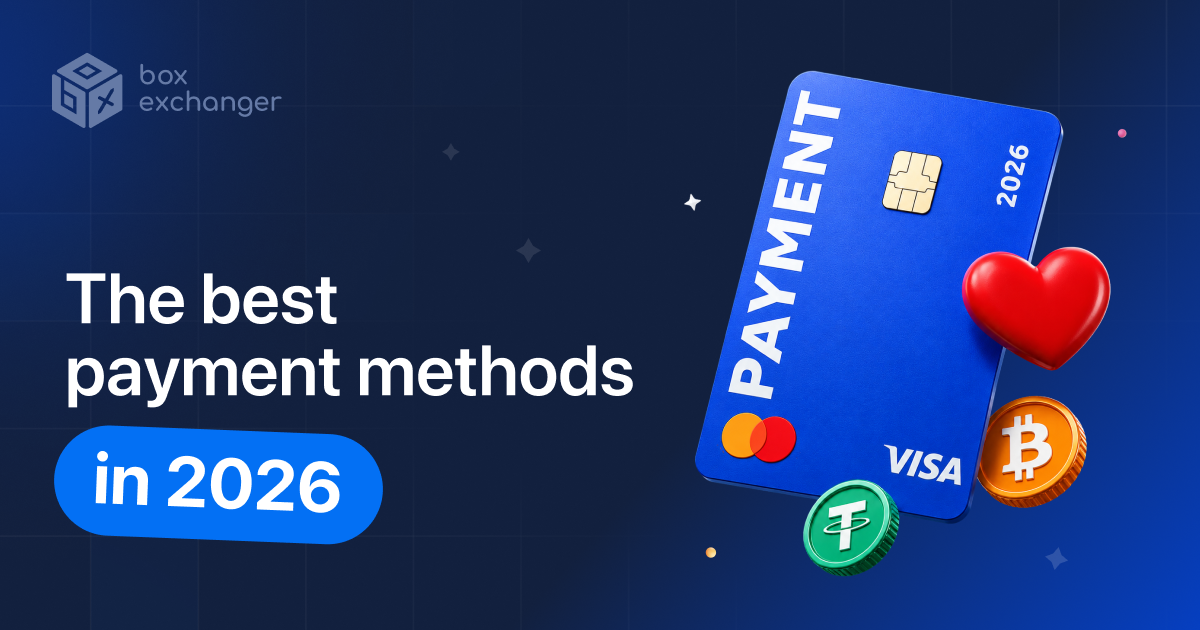
The payments market in 2026 is changing faster than companies themselves can adapt. Users want to pay for a purchase in two taps, while businesses know the cost of delay all too well: every extra step at checkout drives some customers away. Over the past two years, the balance between cards, wallets, and instant transfers has shifted noticeably. This looks more like a change in the habits of an entire generation of buyers than a short-term trend. Below, we will examine which payment methods actually work today, why businesses need to offer several methods at once, and what will determine transaction values in a few years.
How the Payments Market Changed in 2026
Digital wallets accounted for 56% of the global e-commerce volume in 2025. By comparison, credit cards accounted for 20%, debit cards for 10%, direct account-to-account transfers for 7%, and instalment payments for 4%. These figures are provided in the eleventh annual Worldpay Global Payments Report. Wallets are also ahead at physical points of sale, although cards and cash still retain a significant share in certain regions.
The United States has its own particular dynamics: cards still maintain their position at in-store checkouts, but online, wallets already account for 40% of transactions, while cards account for 32%, debit cards for 16%, and instalment payments for around 6%. This is not abstract statistics: payment types in 2026 are shaping a new checkout logic in which speed matters more than habit, while familiar methods lose market share year after year.
Which Payment Methods Users Choose Today
Younger audiences are setting the tone. Among users aged 18–24, mobile payments are already the main way to pay for online purchases, accounting for 39%. Among the slightly older 25–34 age group, the figure is even higher at 41%. The annual volume of payments made through apps increased from $9.3 trillion in 2024 to $10.6 trillion in 2025, and growth will continue. Modern payment methods are built on three foundations: biometrics for authentication, embedded wallets within apps, and instant transfers between accounts. Cards have not disappeared, but they are increasingly used simply as a source of funds for a wallet rather than as an independent payment method at checkout. Payment service developers confirm that the fewer steps there are between the desire to buy and payment confirmation, the higher the purchase completion rate.
Why It Is Important to Offer Customers Several Payment Methods
The Baymard Institute, which studied more than 200,000 hours of checkout usability testing, found that 10% of customers abandon their baskets specifically because they cannot find the payment method they need. This is not insignificant compared with the overall average basket abandonment rate of 70%. A company loses a customer not because of the price or delivery, but because of basic technical incompatibility at the final step.
According to the same data, the average checkout displays around 23 form fields by default, although 12–14 is considered optimal, and every additional field reduces the likelihood of completing the payment. Offering different payment methods at the same checkout removes this risk: if a card is declined or a user refuses on principle to enter their card number online, they should have a one-click alternative without having to reload the entire page.
Which Payment Methods Are Most Popular in Different Countries and Regions
Geography dictates its own rules. In India, the UPI system processes more than 640 million transactions per day, surpassing Visa by this measure, and accounts for 84% of all digital payments in the country. In Brazil, the instant payment system Pix has processed 196.2 billion transactions worth $16 trillion since November 2020. More than 170 million people use it, representing 93% of the country’s adult population. Notably, Pix reached mass adoption faster than UPI, even though UPI itself inspired the Brazilian system. The United States currently maintains a balance between cards and wallets, while local bank transfers and open banking are gaining importance in Europe.
There is no universal formula: payment systems that become widely adopted in one country within a few years may remain niche in another even after a decade.
What Factors Influence the Choice of Payment Method
Checkout speed determines almost everything. If checkout requires more than ten fields, some customers will leave before paying, without even reaching the method selection stage. Trust in the payment provider’s brand acts as reassurance: people are more willing to pay through a service with a recognisable logo than through an unfamiliar widget.
Regional habits have not disappeared either. In some places, bank transfers feel more familiar than cards, while in others cash still retains a share of the market, particularly among age groups over forty. The type of device also matters: purchases made on a phone almost always imply one-tap payment, whereas desktop users are more comfortable entering card details manually.
Finally, there is the transaction cost for the business itself: electronic payment methods such as instant transfers often cost less than card acquiring, which directly affects margins when working with low-value transactions.
Which Technologies Are Shaping the Future of Payments
Biometrics are no longer futuristic. The FIDO Alliance has recorded the global scale of passkey adoption: more than 5 billion active keys, while around 90% of surveyed consumers are already aware of the technology and three quarters have enabled it at least once. Payment by face or fingerprint is gradually merging with digital identity: a passport, boarding pass, and purchase receipt are increasingly linked to a single biometric profile. Stablecoins are also growing in parallel.
According to FXC Intelligence, the potential volume of cross-border payments made with stablecoins exceeds $17.9 trillion, although their actual share is still below 1% of the global cross-border transfer market. Major players are already betting on this area: for example, in 2026 Mastercard completed the acquisition of stablecoin provider BVNK for almost $1.8 billion in order to combine traditional card rails with blockchain settlements within a single infrastructure.
Analysts suggest that stablecoins could capture between 5% and 20% of the cross-border settlement market over the next few years, while the fastest growth is currently taking place in the B2B segment. The payment infrastructure of the future is being built around instant settlements and a minimal number of intermediaries between buyers and sellers.
How Businesses Can Choose the Best Payment Methods for Their Customers
The starting point should be the audience, not trends. If most traffic comes from mobile apps, wallets and biometric authentication are more important than a traditional card payment form. For B2B payments and cross-border settlements, it is worth considering stablecoins: they offer lower fees and faster settlement times, especially on routes between emerging markets where banking infrastructure operates more slowly.
This is particularly relevant for cryptocurrency exchanges and platforms dealing with currency operations. The BoxExchanger platform helps launch and configure an online exchange service where the owner independently determines the set of exchange directions and payment methods best suited to their audience. The best payment methods for a business do not necessarily match overall market trends. More important are the methods that have been tested on the company's own audience and proven by conversion statistics rather than simply copied from competitors.
It is better not to test every payment method at once, but instead to start with two or three of the most suitable options for a specific niche, measure the conversion rate for each, and gradually introduce additional methods as the audience grows and customer demand increases.
Common Mistakes Companies Make When Choosing Payment Methods
The first mistake is copying a competitor's payment options without testing them on your own audience. What works for a large marketplace with millions of orders does not necessarily suit a niche store serving a much smaller customer base.
The second mistake appears when entering a new market: companies ignore local payment habits and try to impose card payments on customers who have long been accustomed to instant account-to-account transfers. Conversion rates almost inevitably decline, and it may take months to recover previous performance.
The third mistake is common among growing businesses. They introduce a new payment method but fail to test it with real users, then wonder why payment methods that appear popular on paper deliver no real growth. Without training the support team and providing clear instructions for customers, even an effective payment method may remain underused.
The final, less obvious mistake is failing to update the payment stack for years while competitors introduce new payment methods and gradually attract customers who value payment speed more than loyalty to an established brand.
Conclusion
The choice of payment method has long ceased to be merely a technical issue for developers and has become part of the overall product experience. Companies that monitor regional preferences, test new payment methods, and eliminate friction at checkout achieve higher conversion rates without increasing their marketing budgets. The BoxExchanger platform is a good example of this approach: its flexible configuration of exchange directions and rates simplifies exactly the stage where businesses most often lose customers — the payment process.
The information provided in this article is for informational purposes only and should not be considered a guide to action, financial recommendation, or investment advice. Investing in cryptocurrency involves a high level of risk, and every investor should conduct their own research, assess their financial situation, and consult qualified financial advisers before making any investment decisions.
Frequently Asked Questions
What is the most popular payment method in the world today?
Digital wallets. They account for 56% of the global online payment volume, outperforming both cards and bank transfers, and continue to grow faster than any other payment method.
Should small businesses adopt stablecoins?
For most industries, it is still too early: stablecoins account for less than 1% of the global payment volume. However, for cross-border B2B settlements and cryptocurrency-related services, they are already a practical tool that offers significant savings on transaction fees.
Why do customers abandon their shopping baskets because of payment options?
One in ten customers leaves if they cannot find their preferred payment method at checkout. The solution is straightforward: offer at least two or three payment methods simultaneously and do not hide alternative options behind unnecessary clicks.
Also read
August 27, 2026
What is MiCA: the EU regulation that rewrote the rules of the crypto market
Europe has closed the era when a crypto exchange service could operate under national registration without looking ...
August 13, 2026
What is PayFi: payment finance on the blockchain
Money in cross-border transfers is almost always sitting somewhere waiting. The sender has already parted with the ...
August 5, 2026
What Is a Crypto Bank: How It Works and How It Differs from a Traditional Bank
A layer of licensed institutions has grown around cryptocurrency, managing fiat currencies and tokens within a sing...