'%3e%3cpath%20d='M10%2020C7.34784%2020%204.8043%2018.9464%202.92893%2017.0711C1.05357%2015.1957%200%2012.6522%200%2010C0%207.34784%201.05357%204.8043%202.92893%202.92893C4.8043%201.05357%207.34784%200%2010%200C12.6522%200%2015.1957%201.05357%2017.0711%202.92893C18.9464%204.8043%2020%207.34784%2020%2010C20%2012.6522%2018.9464%2015.1957%2017.0711%2017.0711C15.1957%2018.9464%2012.6522%2020%2010%2020ZM10%2018C12.1217%2018%2014.1566%2017.1571%2015.6569%2015.6569C17.1571%2014.1566%2018%2012.1217%2018%2010C18%207.87827%2017.1571%205.84344%2015.6569%204.34315C14.1566%202.84285%2012.1217%202%2010%202C7.87827%202%205.84344%202.84285%204.34315%204.34315C2.84285%205.84344%202%207.87827%202%2010C2%2012.1217%202.84285%2014.1566%204.34315%2015.6569C5.84344%2017.1571%207.87827%2018%2010%2018ZM9%2010.41V4H11V9.59L14.95%2013.54L13.54%2014.95L9%2010.41Z'%20fill='%23616F96'/%3e%3c/g%3e%3cdefs%3e%3cclipPath%20id='clip0_3717_10620'%3e%3crect%20width='20'%20height='20'%20fill='white'/%3e%3c/clipPath%3e%3c/defs%3e%3c/svg%3e) 8 min.
8 min.
What is MiCA: the EU regulation that rewrote the rules of the crypto market
Added: August 27, 2026
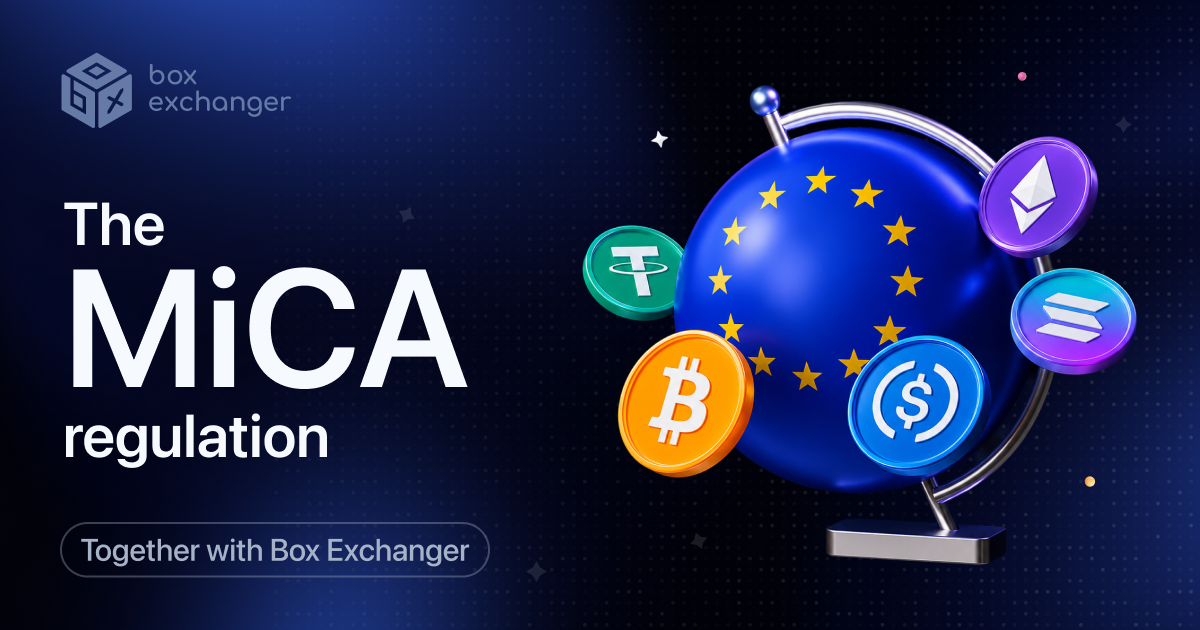
Europe has closed the era when a crypto exchange service could operate under national registration without looking to Brussels. As of 1 July 2026, the transitional periods have expired in all EU countries, and a platform without a European licence serving clients from the EU has found itself operating outside the law. Therefore, the question of what MiCA is has ceased to be theoretical for the owner of an exchange service: the answer determines access to 27 markets at once.
What is MiCA
MiCA is Regulation (EU) 2023/1114 on markets in crypto-assets, adopted on 31 May 2023 and published in the Official Journal of the EU on 9 June. The abbreviation stands for Markets in Crypto-Assets. The format matters: unlike a directive, a regulation applies directly, without having to be transposed into the national law of each country. The document covers three areas: the issuance of crypto-assets, the activities of service providers and the prohibition of market abuse.
Why the European Union adopted the MiCA regulation
Until 2023, each country decided for itself. France introduced the PSAN regime, Germany issued licences for crypto custody, while Lithuania limited itself to registration. A company operating legally in one jurisdiction could find itself in a grey area in a neighbouring one, and cryptocurrency regulation in the EU resembled a patchwork quilt. The collapse of Terra and FTX in 2022 added a second argument: token holders had neither a right of redemption nor access to issuer reporting. The MiCA regulation closes both gaps.
Who is subject to MiCA requirements
The document covers three groups: issuers of asset-referenced tokens (ART), issuers of electronic money tokens (EMT) and crypto-asset service providers, also known as CASPs. The latter include exchanges, exchange services, custodians, brokers, advisers and portfolio managers. Geography is determined by the client, not the office: a company from a third country that actively attracts EU residents must obtain authorisation from the regulator of one of the EU Member States.
Which crypto-assets are regulated by MiCA
The market is divided into three categories:
- ART - tokens referenced to a basket of assets, currencies or commodities;
- EMT - tokens referenced to a single official currency, i.e. traditional fiat-backed stablecoins;
- other crypto-assets - Bitcoin, Ether, utility tokens.
For the third category, an issuer licence is not required, but a white paper describing the project, risks and energy consumption must be submitted to the national authority by way of notification.
Which crypto-assets and areas are not covered by MiCA
Article 2 excludes unique non-fungible tokens, crypto-assets qualifying as financial instruments under MiFID II, deposits, securitisation positions, insurance and pension products. Central banks acting within the framework of monetary policy and the future digital euro are also outside its scope. DeFi is a separate matter: if a service operates in a fully decentralised manner and there is no intermediary, there is no one to whom requirements can be applied. The uniqueness of NFTs is assessed on substance rather than by label: a series of ten thousand similar images is fungible.
Main MiCA requirements for crypto companies
The set of obligations for CASPs looks much like banking regulation. Own capital under Annex IV: €50,000 for advice, reception and transmission of orders, €125,000 for custody and exchange, €150,000 for a trading platform, or one quarter of the fixed overheads of the preceding year if that amount is higher. This is followed by the segregation of client assets, written conflict-of-interest policies, checks on the business reputation of management, a business continuity plan and a complaints-handling procedure with fixed response deadlines.
CASP licence: what it is and who needs it
Authorisation is granted for specific services from the ten listed in Article 3(1)(16): custody, operation of a trading platform, exchange for fiat funds, exchange for other crypto-assets, execution of orders, placing, reception and transmission of orders, advice, portfolio management and transfer. The main benefit is passporting: a licence from one country opens up the entire EEA without repeated procedures. Banks, investment firms and electronic money institutions follow a simplified route through notification.
How MiCA regulates stablecoins
EMTs may only be issued by a credit institution or an electronic money institution with European authorisation. The token is sold at par value, redeemed on demand at any time and also at par value, while the payment of interest to holders is prohibited. At least 30% of the funds received are held in separate accounts with credit institutions, with the threshold rising to 60% for significant tokens. If an ART within a single currency area consistently exceeds 1 million transactions and €200 million per day, Article 23 requires issuance to be stopped.
MiCA requirements for investor and client protection
Article 13 gives a retail purchaser 14 calendar days to withdraw from the transaction without fees and without giving a reason; the rule applies as long as the asset has not been admitted to trading. The issuer is financially liable for an incomplete or misleading white paper. A custodian is liable to the client for the loss of crypto-assets or access keys up to their market value. Rates, fees and the climate footprint are disclosed publicly.
How MiCA regulates advertising and promotion of crypto-assets
Marketing materials must be clearly identified as advertising, must not contradict the white paper and must contain a warning about the risk of losing the entire amount invested. Promises of returns, presenting past growth as a guarantee of future performance and failing to disclose fees are expressly prohibited. Materials are published on the website and provided to the regulator upon request. For an exchange service, this means that a banner saying “a rate better than the market” without disclosing the spread becomes grounds for a complaint.
AML and KYC in the context of MiCA regulation
The regulation itself does not contain anti-money laundering rules: MiCA regulation governs market access, while anti-money laundering requirements are contained in separate related acts. Regulation (EU) 2023/1113 has applied since 30 December 2024, together with the explanatory EBA guidelines: sender and recipient data accompany every crypto transfer regardless of the amount, while the €1,000 threshold has been retained for fiat payments. From 10 July 2027, AMLR will apply: anonymous accounts and coins with enhanced anonymity will be prohibited for obliged entities.
When MiCA entered into force and what transitional periods are provided
The document entered into force on 29 June 2023. Titles III and IV on stablecoins became applicable on 30 June 2024, while the remaining provisions applied from 30 December 2024. Article 143(3) allowed countries to give existing service providers up to 18 months to obtain a licence, but each country decided for itself: in some states the window closed as early as 30 June 2025, while in others it closed in December of the same year. The final deadline falls on 1 July 2026, and the text contains no extension mechanism.
How MiCA affects crypto exchanges and crypto exchange services
The impact of MiCA on cryptocurrencies can be seen most clearly in the case of USDT. Tether did not seek EMT authorisation, and platforms removed trading pairs: Coinbase in December 2024, Crypto.com in January 2025, Binance and Kraken in March. No one prohibited private individuals from holding and transferring USDT, but trading it on a licensed platform in the EEA became impossible. For an exchange service, this means restructuring its offering: some exchange directions disappear, while liquidity shifts to USDC and EURC.
How MiCA affects ordinary cryptocurrency users
Users gain a verifiable counterparty: the ESMA register is public, and a licence can be found by searching the name of the legal entity. At the same time, MiCA rules do not apply to non-custodial wallets, P2P or exchanges on decentralised platforms, so responsibility there remains with the individual. The downside is noticeable: the choice of assets on regulated services has narrowed, while verification has become mandatory everywhere, including small one-off exchanges where an email address used to be sufficient.
Advantages and disadvantages of MiCA regulation
The advantages are obvious for those planning to scale: one authorisation instead of 27 procedures, clear capital requirements and the question of “is this legal?” removed for banks and payment partners. The disadvantages are measured in money and time. Preparing documentation, hiring a compliance officer, auditing and capital requirements push smaller services out of the market. One telling detail: in a year and a half of the regulation being in effect, not a single ART issuer obtained authorisation, even though this category is described in the text in greater detail than the others. Reserve and capital requirements proved more burdensome than the expected revenue.
What companies face for violating MiCA requirements
MiCA gives national regulators the power to impose fines, suspend services, publicly name offenders and revoke authorisation. Significant token issuers are supervised by the EBA: in June 2026, it put out for consultation a methodology for calculating fines: up to 12.5% of annual turnover for significant ARTs and up to 10% for significant EMTs, or twice the amount of the benefit obtained if it can be calculated. In parallel, ESMA maintains a public list of non-compliant companies.
The future of the EU crypto market after MiCA implementation
By August 2026, the ESMA register contains more than three hundred authorised CASPs, around two dozen EMT issuers and no ART issuers. Germany and the Netherlands lead in the number of licences. Revisions to the stablecoin section are being discussed: the concentration of dollar liquidity with a single issuer concerns the Commission no less than unregulated tokens. DeFi and NFTs remain open issues, which are expected to be addressed by a separate package.
Conclusion
MiCA does not prohibit cryptocurrencies and does not in itself make them safer: it determines who is entitled to work with clients’ funds and under what conditions. For the owner of an exchange service, the choice is simple: either a CASP licence and access to the entire EEA, or operation outside the European regulatory perimeter without clients from the Union. The BoxExchanger platform covers the technical side of launching an exchange service, while the owner handles the legal status and preparation for authorisation independently.
The information presented in this article is for informational purposes only and does not constitute a guide to action, financial recommendation or investment advice. Investing in cryptocurrency involves a high level of risk, and every investor should conduct their own analysis, assess their financial capabilities and consult professional financial advisers before making investment decisions.
Frequently Asked Questions
Is a CASP licence required if the company is registered outside the EU?
Yes, if the service actively attracts clients from the Union. A client approaching a foreign platform on their own initiative is not prohibited by the regulation, but marketing, website localisation and acceptance of European payment methods are treated as operating in the EU market.
Can USDT still be held in the EU?
Yes. The restriction concerns not ownership, but the offering of the token by licensed platforms. Holding it in a non-custodial wallet, transfers and exchanges on decentralised services remain available.
How long does it take to obtain a CASP licence?
The regulator checks the completeness of the application within 25 working days and then carries out a substantive assessment within 40 working days. In practice, taking into account requests for additional documents, the process can take 6-12 months.
Also read

September 23, 2026
KYB in Cryptocurrency: What It Is and How Business Verification Works
Every bank, payment processor, and major exchange sooner or later asks a crypto service not for the director's pass...

September 18, 2026
Loyalty Programme for a Crypto Exchange: Mechanics and Benefits
Crypto exchanges compete almost exclusively on exchange rates and the speed of order processing, while the differen...

September 4, 2026
Anti-Fraud System for a Crypto Exchange: How It Works
In 2024, addresses flagged as illegal received $40.9 billion, whilst the amount of funds stolen from services rose ...