'%3e%3cpath%20d='M10%2020C7.34784%2020%204.8043%2018.9464%202.92893%2017.0711C1.05357%2015.1957%200%2012.6522%200%2010C0%207.34784%201.05357%204.8043%202.92893%202.92893C4.8043%201.05357%207.34784%200%2010%200C12.6522%200%2015.1957%201.05357%2017.0711%202.92893C18.9464%204.8043%2020%207.34784%2020%2010C20%2012.6522%2018.9464%2015.1957%2017.0711%2017.0711C15.1957%2018.9464%2012.6522%2020%2010%2020ZM10%2018C12.1217%2018%2014.1566%2017.1571%2015.6569%2015.6569C17.1571%2014.1566%2018%2012.1217%2018%2010C18%207.87827%2017.1571%205.84344%2015.6569%204.34315C14.1566%202.84285%2012.1217%202%2010%202C7.87827%202%205.84344%202.84285%204.34315%204.34315C2.84285%205.84344%202%207.87827%202%2010C2%2012.1217%202.84285%2014.1566%204.34315%2015.6569C5.84344%2017.1571%207.87827%2018%2010%2018ZM9%2010.41V4H11V9.59L14.95%2013.54L13.54%2014.95L9%2010.41Z'%20fill='%23616F96'/%3e%3c/g%3e%3cdefs%3e%3cclipPath%20id='clip0_3717_10620'%3e%3crect%20width='20'%20height='20'%20fill='white'/%3e%3c/clipPath%3e%3c/defs%3e%3c/svg%3e) 8 min.
8 min.
What Is Gas Fee and How to Account for It
Added: April 10, 2026
Updated: May 18, 2026
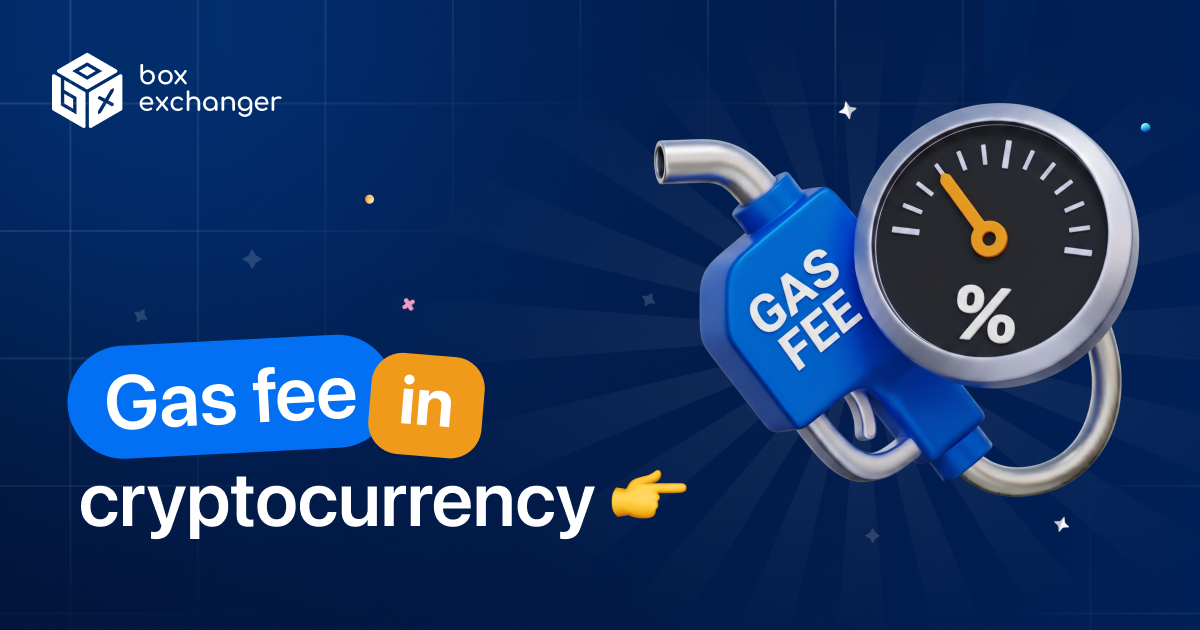
What gas fee is and how to account for it
Every time a user sends tokens, calls a smart contract, or exchanges assets in DeFi, the blockchain charges them an additional line of expenses — a network fee. For a beginner, it looks like a random surcharge that changes without warning. In reality, there is a clear economic logic behind it, and anyone who regularly works with cryptocurrency needs to understand it: from an ordinary holder to an exchange service operator. In this article, we break down the mechanics of gas from basic concepts to practical ways to reduce costs.
What gas fee is in simple terms
What gas fee is — it is the payment for the computational resources that the network spends on processing a transaction. The term came from Ethereum: the creators of the project compared computational operations to fuel consumed by the blockchain “machine.” Without this fee, anyone could endlessly spam the network with zero-value transactions — gas fee makes such behaviour expensive and economically impractical.
The fee is not fixed and is not set by an exchange or an exchanger — it is calculated by the protocol itself. The final amount depends on the network load at the moment of the operation.
How gas fee works in the blockchain
Ethereum processes transactions in blocks, and each block has a limit on the total gas. To get into the next block, a transaction must offer a price that the validator will accept. The documentation on ethereum.org describes it this way: the user sets the maximum amount they are ready to pay, and the network calculates the base part automatically.
August 2021 changed the rules: the EIP-1559 upgrade divided the fee into base fee and priority fee. Base fee is burned by the network, while priority fee is an optional tip for the validator. An important detail about base fee: the protocol moves it depending on how full the blocks are. Full blocks — the price creeps upward, empty ones — it falls back. Moreover, the change for one block cannot exceed 12.5%.
What gas fee consists of
The final gas fee is calculated by the formula:
Gas fee = Gas Limit × (Base Fee + Priority Fee)
- Gas Limit — the gas ceiling for a specific transaction. The figures here are not the same: an ETH transfer between wallets always costs exactly 21,000 units, while smart contracts are more demanding — from 50,000 to 200,000+, depending on what exactly the contract does.
- Base Fee — the part of the fee that cannot be negotiated: the protocol sets it itself for each block, and it is burned. The strict 12.5% limit on the change from block to block was not introduced by accident: without it, one NFT hype wave could send the fee sky-high within minutes.
- Priority Fee (tip) — an optional tip for the validator. This is what determines speed: 1–2 gwei is enough when the network is not loaded. But once the market becomes more active — competition to get into a block pushes the tip up to 10, 30, and in hot moments even to 50+ gwei.
A specific example from the documentation on ethereum.org: 21,000 units of gas multiplied by (10 + 2) gwei gives 252,000 gwei, or 0.000252 ETH on top of the transfer. The extra gas that the transaction did not spend will be returned by the network — so an overestimated limit is not a disaster, but an underestimated one is much worse.
What gwei is and how it is connected to gas fee
The gas price is expressed in gwei — a unit equal to one billionth of ETH (10-9 ETH). It is counted in gwei because ETH is inconvenient for such calculations: writing 0.000000010 ETH is a torment. One gwei is one billionth of ETH, and this is the working unit. Now, in the middle of 2025, a calm day on Ethereum means 2–5 gwei for gas, and a simple transfer fits within one dollar.
What the cost of gas fee depends on
Three factors determine the result:
- Demand for block space. The more transactions compete to get into a block, the higher the base fee. Periods of large NFT drops, launches of popular DeFi protocols, or general market growth instantly raise fees.
- Complexity of the operation. A simple ERC-20 transfer requires ~45,000–65,000 units of gas, while calling a complex smart contract requires 150,000–300,000. Gas fee ERC20 when sending tokens is always higher than with a simple transfer of the native coin.
- User settings. The higher the priority fee, the faster the transaction will get into a block. Low tips when the network is loaded mean the risk of getting stuck in the mempool queue for hours.
Why fees can rise sharply
Sharp spikes happen in several scenarios. First, hype events — a major NFT mint or excitement around a new token forces thousands of users to raise priority fee at the same time in order to outpace each other in the mempool queue.
In May 2022, the mint of the Otherside collection by Yuga Labs pushed the average gas up to 6,000+ gwei, and some users paid more than $10,000 for a single transaction. Second, periods of overall market growth increase transaction activity: more swaps, liquidations, and arbitrage — all of this competes for space in the block. Third, technical incidents — attacks or major on-chain events — can fill blocks to the limit in a one-off way.
According to CoinGecko, in 2024 Ethereum collected $2.48 billion in fees, and peak days brought in up to $23 million per day. With the introduction of L2 solutions and the Dencun upgrade (March 2024), the network’s daily fee income fell to ~$6.3 million — capacity was distributed to the second layer.
How to account for gas fee correctly in operations
Gas fee is an expense that changes in real time, so it cannot be ignored when calculating the final outcome of a deal. A few rules:
- Look at the final amount, not only the asset price. With small volumes, the fee can amount to 5–15% of the value of the operation.
- Check the current gas level before sending via trackers such as Etherscan Gas Tracker — slow/standard/fast ranges are visible there.
- Take into account that what gas is in crypto is not just a cost, but also a signal of load: high gas means an overloaded network and the risk of transaction delays even with standard settings.
For operators of exchange services, this is especially important: the BoxExchanger platform allows automatic recalculation of rates taking network fees into account, so that the final amount for the client reflects the real costs of executing the request.
How to reduce gas fee
There are several working methods:
- Choose the timing. On weekends and during night hours by UTC, the load on Ethereum is traditionally 15–25% lower. The current slow/standard/fast ranges can conveniently be tracked through Etherscan Gas Tracker or the Blocknative extension.
- Use L2 networks. Arbitrum, Optimism, and Polygon process transactions outside the main chain and pass the data in batches. According to CoinLaw, the average fee in 2025 on Arbitrum is ~$0.009 versus $3.78 on Ethereum L1 — a 400-fold saving on an identical operation.
- Control gas limit. Wallets such as MetaMask allow you to adjust the limit manually. The main thing is not to lower it to a critical level: an operation with an insufficient limit will end with an error, and the gas already spent will not be returned.
- Combine operations where possible. A number of protocols support multicall — several actions in one transaction. This saves the fixed 21,000 units of base gas that would otherwise be spent on each separate operation.
- Use gas tokens or account abstraction. EIP-4337 allows a dApp to pay gas for the user through smart accounts — this mechanism is already used in a number of DeFi applications to attract a new audience.
Gas fee in different networks: a brief comparison
Network | Average fee (2025) | Features |
Ethereum L1 | ~$0.44-3.78 | Base fee is burned, high decentralisation |
Arbitrum | ~$0.009 | Optimistic rollup, EVM-compatible |
Polygon | ~$0.001-0.008 | Sidechain + zkEVM, popular for NFT |
BNB Smart Chain | ~$0.05-0.20 | PoSA, 21 validators, fast |
Solana | ~$0.00025 | Proof of History, parallel processing |
Common mistakes when working with gas fee
- Setting the gas limit too low. The transaction will fail with an out-of-gas error, and the fee will not be returned — the network spent resources on the attempt.
- Copying the gas limit from the previous transaction. The complexity of smart contracts differs from one operation to another.
- Ignoring the fee when exchanging small amounts. A $20 swap on Ethereum L1 with a loaded network can cost $8–15 in fees.
- Not checking the balance of the native token. To send USDT on the Ethereum network, you need ETH on the balance — gas is paid in it, not in USDT itself.
- Sending a transaction with an outdated nonce. If the previous transaction got stuck in the mempool with low gas, all subsequent ones from the same address will line up in the queue. The solution: send a “replacement” transaction with the same nonce, but a higher priority fee — the network will include it in the block and automatically cancel the stuck one.
How gas fee affects cryptocurrency exchange
In online exchangers, the network fee is part of the cost of the operation. The exchanger either includes it in the spread or shows it as a separate line. Non-transparent presentation is the reason for the disappointment of clients who compare the “rate on the storefront” with the amount received in the account.
A competent exchange service tracks the gas level in real time and includes it in the calculation before the client confirms the request. This is especially critical for directions with gas fee ERC20: sending USDT or USDC on the Ethereum network costs 2–3 times more than a simple ETH transfer because of the smart contract call of the token. The BoxExchanger platform allows automatic recalculation of rates taking current network fees into account — the client sees the final amount before confirmation, not after.
Conclusion
Gas fee is a controllable variable, not a random tax. Knowing what the fee consists of, at what time the network is less loaded, and which L2 solutions are available for a specific task, it is possible to reduce costs by 10–100 times without losing security. For a crypto service operator, this directly affects economics: transparent gas calculation is a competitive advantage, not a technical nuance.
The information presented in this article is for informational purposes only and does not constitute a guide to action, financial advice or investment advice. Cryptocurrency investments involve a high level of risk, and each investor should conduct their own analysis, assess their financial capabilities and consult with professional financial advisors before making investment decisions.
Frequently Asked Questions
Is gas fee refunded if the transaction fails?
No. If a transaction fails with an out-of-gas error or is rejected, the gas that was used is not refunded — the network has still spent resources on processing it. The unused remainder within the set Gas Limit is returned.
Is it possible not to pay gas fee at all?
Not directly — gas is built into the protocol. However, some dApps and exchangers cover the fee themselves through the account abstraction mechanism (EIP-4337), and the user interacts with the network without an explicit payment from their own wallet.
Why is the fee in ETH if I am sending USDT?
Because USDT on Ethereum is a smart contract on the Ethereum network, and the execution of any code in that contract is paid for with gas in the network’s native currency, that is, ETH. The USDT balance itself cannot cover the network fee.
Also read

October 18, 2026
Legal Documents for a Crypto Exchange: What to Prepare Before Launch
Since July 1, 2026, the issue of paperwork in crypto exchange has become much more serious: the MiCA transitional p...
October 2, 2026
Cryptocurrency Exchange Business Plan: What It Consists of and How to Calculate the Launch
There are hundreds of exchange services today, and a new project is not entering an empty market. Most often, it st...
September 23, 2026
KYB in Cryptocurrency: What It Is and How Business Verification Works
Every bank, payment processor, and major exchange sooner or later asks a crypto service not for the director's pass...