'%3e%3cpath%20d='M10%2020C7.34784%2020%204.8043%2018.9464%202.92893%2017.0711C1.05357%2015.1957%200%2012.6522%200%2010C0%207.34784%201.05357%204.8043%202.92893%202.92893C4.8043%201.05357%207.34784%200%2010%200C12.6522%200%2015.1957%201.05357%2017.0711%202.92893C18.9464%204.8043%2020%207.34784%2020%2010C20%2012.6522%2018.9464%2015.1957%2017.0711%2017.0711C15.1957%2018.9464%2012.6522%2020%2010%2020ZM10%2018C12.1217%2018%2014.1566%2017.1571%2015.6569%2015.6569C17.1571%2014.1566%2018%2012.1217%2018%2010C18%207.87827%2017.1571%205.84344%2015.6569%204.34315C14.1566%202.84285%2012.1217%202%2010%202C7.87827%202%205.84344%202.84285%204.34315%204.34315C2.84285%205.84344%202%207.87827%202%2010C2%2012.1217%202.84285%2014.1566%204.34315%2015.6569C5.84344%2017.1571%207.87827%2018%2010%2018ZM9%2010.41V4H11V9.59L14.95%2013.54L13.54%2014.95L9%2010.41Z'%20fill='%23616F96'/%3e%3c/g%3e%3cdefs%3e%3cclipPath%20id='clip0_3717_10620'%3e%3crect%20width='20'%20height='20'%20fill='white'/%3e%3c/clipPath%3e%3c/defs%3e%3c/svg%3e) 6 min.
6 min.
Main fraud schemes in crypto exchanges
Added: May 5, 2026
Updated: May 26, 2026
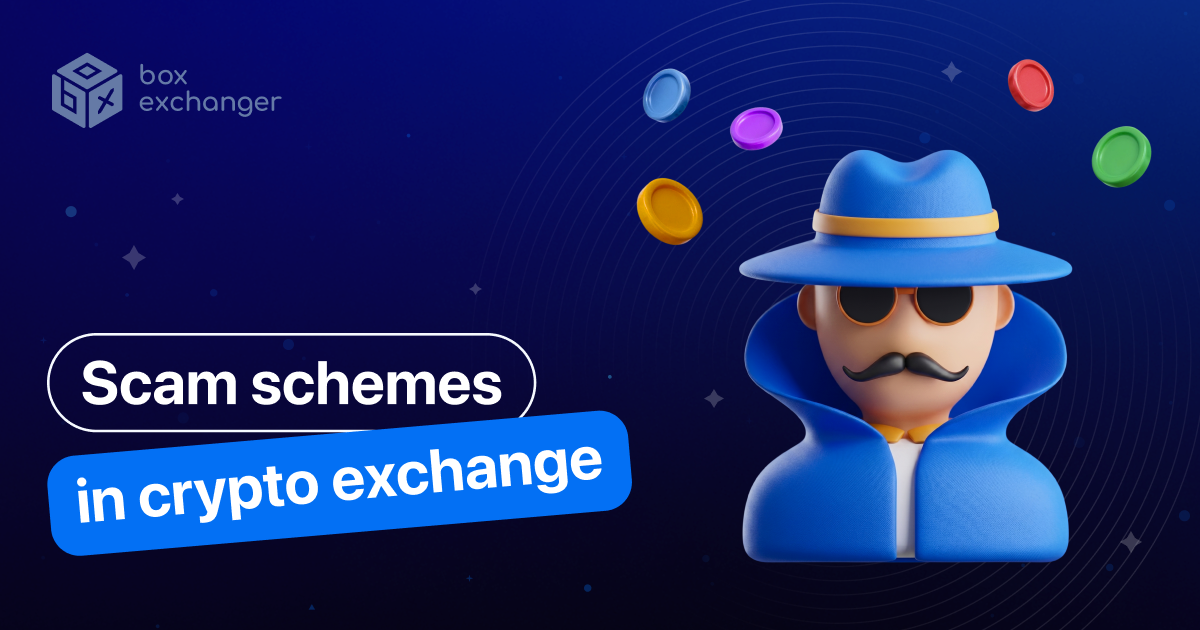
The crypto exchange market is growing faster than user protection mechanisms can keep up. Behind every attractive exchange rate there may be a trap: a fake website, malicious software, or a carefully constructed trust scheme. According to the 2024 report by FBI IC3, Americans lost more than $9.3 billion to crypto fraud - cryptocurrency became the primary tool for stealing funds in cybercrime. Below is a breakdown of the main fraud schemes, warning signs of dangerous services, and how a secure exchange process should work.
Why Users Encounter Fraud When Exchanging Cryptocurrency
The crypto market is decentralized by nature: transactions are irreversible, refunds without the service’s involvement are technically impossible, and there is no single regulator. Three structural factors make exchange services an attractive target:
- Transaction anonymity. A user sends real money and waits for crypto - this gap creates a risk window. Nobody verifies the destination wallet.
- Pressure through speed. Rates change every second. Fraudsters exploit this directly: “Send the payment now or the rate will change.” Urgency disables critical thinking.
- Weak regulatory oversight. Chainalysis reports that in 2024, the volume of stolen funds in the crypto sector increased by 21% year over year and reached $2.2 billion. Most jurisdictions still lack full supervision over VASPs (Virtual Asset Service Providers).
Main Fraud Schemes in Crypto Exchanges
There is no single scenario here. Fraud schemes in crypto exchanges fall into several stable categories, each targeting a different level of user vigilance.
Fake exchangers: the website copies the interface and logo of a legitimate service, but the domain differs by one or two characters. The user transfers funds, the transaction “gets stuck” or disappears, and support stops responding. Sometimes the fake service operates for several weeks without incidents - to build credibility before disappearing with a large amount.
Clipboard hijacking: malicious software intercepts the clipboard. The user copies a wallet address, but pastes the attacker’s address instead. The difference may only be a few characters that nobody checks manually. Funds are sent to the wrong destination - and the transaction is already confirmed.
Advance-fee fraud (“fee retention”): after sending funds, the user is told that a small fee must be paid to complete the exchange. The victim pays. Then another requirement appears - a tax, verification fee, or “account unfreezing” charge. Each new payment is reinforced with the logic: “You’ve already invested so much, don’t stop now.” This is classic advance-fee fraud adapted for crypto.
Pig butchering: one of the most destructive crypto exchange scam schemes in terms of losses. According to TRM Labs, these schemes drained more than $4.4 billion in just one year. The fraudster builds trust for weeks through messengers, dating apps, or social networks, then offers a “profitable” investment through a pseudo-exchange or fake platform. The victim invests, sees a growing balance, deposits more funds - and when attempting a withdrawal, the platform disappears.
P2P fraud: users are offered direct exchange without a platform “at the best rate.” Payment arrives as a fake receipt or is reversed through a dispute in the payment system, while the crypto has already been sent.
How to Recognize a Fraudulent Exchange Service
Warning signs visible before the first transfer:
- Domain. Check the address manually: one extra character, .net instead of .com, or a hyphen in an unexpected place is enough reason to close the tab. An SSL lock is not a guarantee: certificates are free and installed within minutes.
- Legal information. A legitimate service provides jurisdiction details, registration data, and working contact information. An empty “About Us” page is a red flag.
- Exchange rate. An offer that is 4-5% better than the market average without a clear reason is bait, not a competitive advantage.
- Reviews. Real reviews exist on independent platforms, not only inside the service itself. If all praise appears exclusively on the exchanger’s own website, it is most likely a simulated reputation.
Financial fraud schemes are often disguised as “new user bonuses”: “+10% to the exchange rate for deposits over $300.” Any offer that sounds too good requires double verification - not just a quick search, but an actual review of the company’s information and exchange history.
How to Protect Yourself When Exchanging Cryptocurrency
Concrete actions, not generic advice:
- Use aggregators with verification. BestChange only lists exchangers that have operated for at least 6 months, maintain reserves above $10,000, and pass the platform team’s verification. This filter eliminates most short-lived fake services.
- Before every transaction, manually verify the recipient address character by character - at least the first and last 6-8 characters.
- Start with a test amount when using a new service.
- Enable two-factor authentication wherever possible. A study by Google Security Blog showed that SMS verification blocks 100% of automated bot attacks and 96% of mass phishing attacks on accounts.
- Do not follow links from messengers unless you are certain about the sender. Internet scam schemes have long moved into Telegram and WhatsApp - this is where phishing links disguised as “profitable rates” and “private groups” are most commonly distributed.
What a Secure Exchange Process Should Look Like
A secure exchange follows predictable logic: first verify the service, then perform the transaction.
Correct algorithm:
- Find an exchanger through an aggregator or a direct, verified link.
- Check the domain, legal information, and the presence of real reviews on external platforms.
- Start with a test amount if you are using the service for the first time.
- Verify the wallet address before sending - not once, but twice, character by character.
- Save the transaction ID and screenshots of the exchange terms until confirmation is complete.
The BoxExchanger platform provides operators with tools for managing rates, exchange directions, and AML settings; this makes it possible to create transparent conditions for clients without hidden fees or spread manipulation.
New fraud schemes do not ask for trust immediately: they build it gradually through small successful transactions, followed by offers of “VIP plans” involving larger sums. Therefore, even a successful test transaction is not a guarantee if the conditions later change.
User Mistakes That Lead to Loss of Funds
Most losses occur not because attacks are technically sophisticated, but because of behavioral patterns:
- Clicking the first link in search results. Google ad blocks and other search engine advertisements are actively used to promote phishing websites. Typing a URL manually takes 5 seconds.
- Trusting screenshots of “successful” payouts. Screenshots are not verified by anything; fake transaction histories can be created within minutes.
- Sharing a seed phrase with “support.” No legitimate service will ever ask for your seed phrase or private key - never, without exceptions.
- Using one device for everything. A browser with a crypto wallet, messengers, and work email all on the same phone means a wider attack surface, not paranoia.
IBM reports that the average cost of a data breach in 2024 reached $4.88 million - a 10% increase compared to 2023. This applies to the corporate sector; retail losses are smaller, but recovering crypto funds after fraud is technically impossible in most cases.
Conclusion
Fraud schemes in crypto exchanges are becoming closer to users: through messengers, phishing advertisements, and fake aggregators. Protection is built not on trusting the interface, but on verifying facts before the transaction. For exchange service operators, this means one thing: transparency of terms and a verified reputation are not marketing tools, but a basic market requirement.
The information presented in this article is for informational purposes only and does not constitute a guide to action, financial recommendation, or investment advice. Cryptocurrency investments involve a high level of risk, and every investor should independently conduct research, assess their financial capabilities, and consult professional financial advisors before making investment decisions.
Frequently Asked Questions
Can funds be recovered if cryptocurrency was sent to a scammer?
In most cases - no. Blockchain transactions are irreversible by protocol. The only chance is if the scammer used a centralized exchange and you managed to file a complaint before the funds were withdrawn. Save the transaction hash, screenshots of correspondence, and contact cyber police and FBI IC3 (ic3.gov).
How can you distinguish a legitimate exchanger from a fake one?
Check three things: the exact spelling of the domain, the legal information on the website (registration and country), and reviews on independent platforms - not only on the exchanger’s own page. Use aggregators with verification, such as BestChange.
What should you do if an exchanger “freezes” and does not process the transaction?
First, check the transaction status in a blockchain explorer using the hash. If the funds left your wallet but did not reach the exchanger’s address, there may be a network delay. If the funds arrived but the exchanger remains silent, document all details in writing, contact support through the official email, and file a complaint on the aggregator where you found the service.
Also read

October 18, 2026
Legal Documents for a Crypto Exchange: What to Prepare Before Launch
Since July 1, 2026, the issue of paperwork in crypto exchange has become much more serious: the MiCA transitional p...
October 2, 2026
Cryptocurrency Exchange Business Plan: What It Consists of and How to Calculate the Launch
There are hundreds of exchange services today, and a new project is not entering an empty market. Most often, it st...
September 23, 2026
KYB in Cryptocurrency: What It Is and How Business Verification Works
Every bank, payment processor, and major exchange sooner or later asks a crypto service not for the director's pass...