'%3e%3cpath%20d='M10%2020C7.34784%2020%204.8043%2018.9464%202.92893%2017.0711C1.05357%2015.1957%200%2012.6522%200%2010C0%207.34784%201.05357%204.8043%202.92893%202.92893C4.8043%201.05357%207.34784%200%2010%200C12.6522%200%2015.1957%201.05357%2017.0711%202.92893C18.9464%204.8043%2020%207.34784%2020%2010C20%2012.6522%2018.9464%2015.1957%2017.0711%2017.0711C15.1957%2018.9464%2012.6522%2020%2010%2020ZM10%2018C12.1217%2018%2014.1566%2017.1571%2015.6569%2015.6569C17.1571%2014.1566%2018%2012.1217%2018%2010C18%207.87827%2017.1571%205.84344%2015.6569%204.34315C14.1566%202.84285%2012.1217%202%2010%202C7.87827%202%205.84344%202.84285%204.34315%204.34315C2.84285%205.84344%202%207.87827%202%2010C2%2012.1217%202.84285%2014.1566%204.34315%2015.6569C5.84344%2017.1571%207.87827%2018%2010%2018ZM9%2010.41V4H11V9.59L14.95%2013.54L13.54%2014.95L9%2010.41Z'%20fill='%23616F96'/%3e%3c/g%3e%3cdefs%3e%3cclipPath%20id='clip0_3717_10620'%3e%3crect%20width='20'%20height='20'%20fill='white'/%3e%3c/clipPath%3e%3c/defs%3e%3c/svg%3e) 6 min.
6 min.
DEX vs. CEX
Added: January 18, 2026
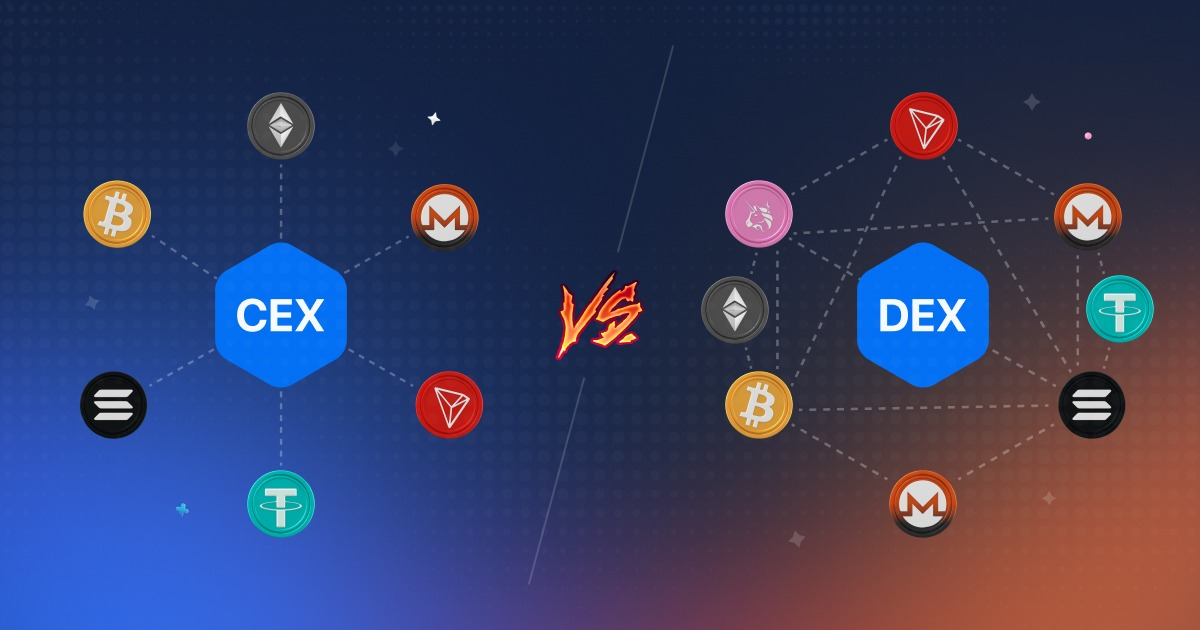
The DEX vs. CEX debate has long gone beyond trading. For the owner of an online exchange, it becomes a question of liquidity sources, settlement speed, and the cost of each conversion. The BoxExchanger script includes an exchange website, admin panel, Telegram bot, and back-end API; the chosen model affects the routing of requests.
There are two architectures in crypto exchange. The first is based on a single operator and internal balance accounting. The second uses smart contracts and blockchain settlements. In both cases, the exchange rate, timing, and transparency of the final amount are important to the customer.
The comparison below is based on market volumes, commissions, security, and regulation.
How the centralised model works
The abbreviation CEX stands for Centralised Exchange: a platform with an operating company that keeps off-chain balance records and matches orders within its infrastructure. Deposits and withdrawals of assets are accompanied by on-chain transactions, and trades in the order book are faster due to internal clearing.
According to CoinGecko's estimates, the top 10 centralised platforms in 2024 generated $17.4 trillion in spot volume. Such scale usually provides deep liquidity for popular pairs and a more stable spread on large amounts.
This is important for an exchange when it comes to automatic hedging: the deeper the order book, the lower the slippage on a market transaction and the more accurate the margin calculation.
How on-chain exchange works through protocols
The abbreviation DEX stands for Decentralised Exchange: exchange via smart contracts and liquidity pools (often the AMM model). The result of the transaction is recorded on the network, and confirmation depends on the blockchain load and gas parameters.
CoinGecko states in its annual report that the top 10 on-chain platforms in 2024 increased their volume to $1.8 trillion, a year-on-year growth of +159.3%. Separate CoinGecko analytics on the share of on-chain spot show a jump in the ratio of on-chain volume to centralised volume to 37.4% in June 2025 and a hold of around 20% in November 2025.
For an on-chain exchange, liquidity helps expand the range of products, connect new tokens faster, and build routes within DeFi when demand shifts to blockchain. In this context, DEX becomes a source of quotes and a transaction executor directly on the network.
Key differences in how transactions work
It is convenient to consider the difference in terms of four parameters: storage, execution, price formation, and operational processes. The DEX vs CEX comparison format helps to summarise this in a short checklist for the team.
1. Storage. In a centralised model, part of the risk is concentrated with the operator (hot wallets, withdrawal procedures, access). In an on-chain model, the user retains control of the keys until the transaction is confirmed.
2. Execution. Centralised clearing provides fast processing within the platform, while on-chain execution depends on the time it takes for the transaction to be included in the block and the selected gas fee. Ethereum.org emphasises that gas fees change as network load increases.
3. Price formation. In the order book, the price is determined by participants' bids. In AMM, the price depends on the ratio of reserves, so a large transaction increases the price impact. Practical conclusion for an exchange: routing by liquidity sources and volume restrictions in a single pool are needed.
4. Operational processes. A centralised exchange is easier to integrate via API for quotes and hedging. On-chain exchange requires control of transaction parameters: slippage, deadline, network selection.
Security: what is included in the risk profile
Security includes cyber protection, key access control, anomaly monitoring, and business process resilience.
Chainalysis estimates the amount of stolen funds in 2024 at $2.2 billion, an increase of about 21% year-on-year. According to the introduction to the Crypto Crime Report, private key compromises accounted for 43.8% of the funds stolen in 2024, with North Korean groups linked to $1.34 billion, or 61% of the annual volume of thefts.
For the exchange, these figures translate into a set of measures: separate roles and access rights, withdrawal limits, hot wallet segmentation, action logging, address verification, and triggers for atypical amounts. When using DeFi routes, protocol risk and integration risk are added, so a list of authorised contracts and regular dependency checks are required.
Commissions and exchange economics
In centralised trading, the base rate is often based on maker/taker and decreases as turnover increases. In the Binance spot schedule, the base rate is listed as 0.1000% for makers and takers, and at high VIP levels, the rate decreases to 0.0160% / 0.0250%; the same schedule also lists a 25% discount when paying fees with BNB.
In on-chain exchanges, the total cost consists of the pool fee and network gas. The Uniswap documentation specifies base fee levels of 0.05%, 0.30% and 1%, with a 0.01% level added through governance. According to Etherscan Gas Tracker, a typical swap on Uniswap v3 is estimated at 184,523 gas units, which shows a difference compared to simple transfers. Ethereum.org provides a benchmark: a standard ETH transfer requires a limit of 21,000 gas.
For an exchange, the economics look like this: for small amounts, gas becomes a significant portion of the costs, and for large amounts, slippage and liquidity source fees often become the key factors.
Regulation and legal framework
Centralised services more often interact with fiat and are subject to AML/KYC requirements. In its updated guidance for virtual assets and VASPs, the FATF describes AML/CFT obligations and a risk-based approach for market participants.
The EU has the MiCA regulation in place: the document sets the date of application as 30 December 2024, and separate sections on asset-referenced tokens and e-money tokens apply from 30 June 2024. For the exchange business, this means increased attention to disclosure, compliance procedures and operational risk management.
What to choose and when
The choice between DEX and CEX can be conveniently linked to three KPIs: execution cost, speed of delivery, and legal framework.
- Execution cost. For popular pairs with high liquidity, a centralised source often provides a narrow spread, while an on-chain route can offer a favourable price with access to the deep liquidity of a specific pool and a suitable network.
- Speed. If the exchange's SLA relies on instant settlement within the platform and fast withdrawal, a centralised scheme simplifies the process. For on-chain exchanges, confirmation time depends on the network and gas.
- Legal framework. When working with fiat and certain jurisdictions, the role of KYC and reporting increases; here, centralised infrastructure usually offers ready-made processes.
In practice, many services build a hybrid and connect CEX and DEX through a single routing: for some directions, they use an exchange API, for others, an on-chain aggregator, and the algorithm chooses the path based on price, slippage, and commission.
On-chain protocols work as code, and the regulatory focus often shifts to access points: interfaces, custodial services, liquidity providers, and companies that serve users.
Pros and cons for an exchange service
1). Centralised approach:
- high liquidity for top pairs, as confirmed by CoinGecko's annual volumes
- clear fee schedule and lower rates as turnover increases
- convenient integration via API for quotes and hedging
2). On-chain approach:
- transparent recording of results in the blockchain and user control of keys
- growth in the share of on-chain spot and stable demand of around 20% in November 2025
- Fixed pool commission levels on popular protocols
- variable part of costs in the form of gas, as seen in examples of gas consumption for swaps
Conclusion
The comparison of DEX vs. CEX for an online exchange boils down to managing three things: liquidity, costs, and risks. The centralised model provides a deep market for mass assets, while on-chain routes expand the range of directions and open up DeFi scenarios. The BoxExchanger script with a website, admin panel, Telegram bot and API helps to bring the process together into a single service and configure the routing of requests for the selected execution model.
The information presented in this article is for informational purposes only and does not constitute a guide to action, financial advice or investment advice. Cryptocurrency investments involve a high level of risk, and each investor should conduct their own analysis, assess their financial capabilities and consult with professional financial advisors before making investment decisions.
Frequently Asked Questions
What metric shows the growth of on-chain exchange relative to centralised platforms?
CoinGecko uses the ratio of spot volume on on-chain platforms to centralised volume; in June 2025, the indicator reached 37.4%, and in November 2025, it remained at around 20%.
What events contribute most to the loss of funds?
Chainalysis recorded $2.2 billion stolen in 2024, with private keys accounting for 43.8% of the stolen funds.
How can you estimate the on-chain costs of a transaction before sending it?
It is convenient to add up the pool commission and network gas; Etherscan shows an example of gas consumption for a Uniswap v3 swap of 184,523, and Ethereum.org gives 21,000 gas for a standard ETH transfer.
Also read
February 28, 2026
How exchange rates work in crypto exchangers and why they differ
Users compare quotes and want to understand how rates work in crypto exchangers: the numbers on the storefront look...

February 24, 2026
How to choose a cryptocurrencty exchanger
The query how to choose a crypto exchange often sounds the same: you want to buy crypto assets, quickly top up your...

January 28, 2026
Cryptocurrency regulation in the EU
Cryptocurrency regulation in the EU has rapidly moved from fragmented national regimes to a single framework: this ...