'%3e%3cpath%20d='M10%2020C7.34784%2020%204.8043%2018.9464%202.92893%2017.0711C1.05357%2015.1957%200%2012.6522%200%2010C0%207.34784%201.05357%204.8043%202.92893%202.92893C4.8043%201.05357%207.34784%200%2010%200C12.6522%200%2015.1957%201.05357%2017.0711%202.92893C18.9464%204.8043%2020%207.34784%2020%2010C20%2012.6522%2018.9464%2015.1957%2017.0711%2017.0711C15.1957%2018.9464%2012.6522%2020%2010%2020ZM10%2018C12.1217%2018%2014.1566%2017.1571%2015.6569%2015.6569C17.1571%2014.1566%2018%2012.1217%2018%2010C18%207.87827%2017.1571%205.84344%2015.6569%204.34315C14.1566%202.84285%2012.1217%202%2010%202C7.87827%202%205.84344%202.84285%204.34315%204.34315C2.84285%205.84344%202%207.87827%202%2010C2%2012.1217%202.84285%2014.1566%204.34315%2015.6569C5.84344%2017.1571%207.87827%2018%2010%2018ZM9%2010.41V4H11V9.59L14.95%2013.54L13.54%2014.95L9%2010.41Z'%20fill='%23616F96'/%3e%3c/g%3e%3cdefs%3e%3cclipPath%20id='clip0_3717_10620'%3e%3crect%20width='20'%20height='20'%20fill='white'/%3e%3c/clipPath%3e%3c/defs%3e%3c/svg%3e) 7 min.
7 min.
Cold Wallet and Hot Wallet
Added: March 12, 2026
Updated: March 26, 2026
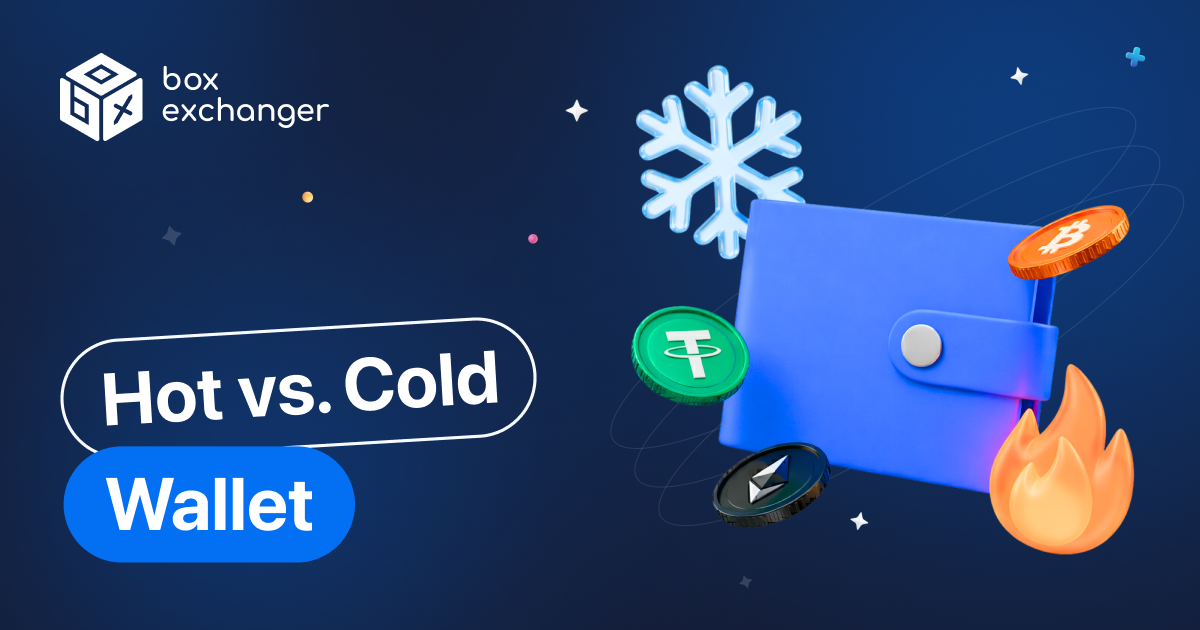
The way you store cryptocurrency determines the level of protection of your assets. A hot wallet is always online. This is convenient, but the keys are constantly at risk. A cold wallet for cryptocurrency keeps keys offline, and it is simply impossible to access them remotely. This difference is the first thing to understand before investing money in crypto.
What Is a Cryptocurrency Wallet
Every wallet is based on two keys: one public and one private. The coins themselves remain on the blockchain. The wallet serves as an entry point — without it, access to assets is impossible.
Inside every wallet there are two keys. The public key works as a receiving address: it can be shared freely without risk. The private key is the owner’s personal signature that confirms every transaction. No key — no access. Customer support is powerless here. The blockchain does not provide any mechanism for recovering keys.
Hot wallets and cold wallets serve different needs. The former are suitable for active trading and frequent transfers. The latter are designed for long-term storage of funds. The choice depends on how exactly you use cryptocurrency.
What Is a Hot Wallet
A hot wallet is software that operates constantly online. Open the app — funds are immediately accessible. Transactions are processed in seconds, and no additional hardware is required.
How a Hot Wallet Works
Private keys reside on a device that is constantly connected to the internet. A transaction is created there — the wallet signs it and sends it to the blockchain. The entire process takes seconds. This is what makes hot wallets indispensable for active operations such as trading, staking, and DeFi protocols.
The main vulnerability of a hot wallet is its постоянное connection to the internet. As long as the device is online, the key is exposed. This is a technical reality, not a flaw: no software update can change it.
Main Types of Hot Wallets
Web wallets are opened in a browser — the keys are stored on the servers of an exchange or provider (MetaMask, Trust Wallet Web). Mobile apps like Trust Wallet and Coinbase Wallet are most often used for everyday spending. Desktop wallets such as Electrum and Exodus store keys locally, but a compromised computer completely nullifies this protection.
Exchange wallets are provided by centralized platforms — in this case, the exchange itself controls the keys, not the user.
Advantages of a Hot Wallet
The main advantage of a hot wallet is speed and accessibility. Setup takes minutes, there are no usage fees, and funds are accessible from anywhere in the world. Traders and DeFi participants appreciate this immediately: in fast-moving markets, every minute of delay translates into losses.
Disadvantages of a Hot Wallet
Vulnerability to cyberattacks is the key drawback. Private keys are stored on a device with a constant internet connection. Malware, phishing attacks, exchange server breaches — all of these are real scenarios for losing funds. The owner of an exchange wallet fully relies on a third-party security system. According to Chainalysis, in 2024 hackers stole approximately $2.2 billion in cryptocurrency. This is 21% higher than the 2023 figure. Most major hacks affected hot wallets: the BtcTurk exchange lost $55 million, and BingX lost $43 million.
What Is a Cold Wallet
A cold wallet stores private keys completely offline. As long as the device is isolated from the internet, it is physically impossible to access it remotely.
How a Cold Wallet Works
The private key is generated and stored on a device without internet access. When a transaction is needed, the user connects the device to a computer and signs the operation offline. A completed signature is sent to the blockchain. The key never leaves the device. That is the essence of cold storage.
Types of Cold Wallets
The most common choice is a hardware wallet. Ledger, Trezor, and Coldcard store keys in a secure chip inside the device. The gadget fits in your pocket. Prices start at $50 and can reach $250 depending on the model.
A paper wallet is a printed key or QR code on a physical medium. It costs nothing to store. There is one weak point: fire, water, or theft can permanently destroy access to funds.
Air-gapped devices (offline computers) have never been connected to the internet. This method is used by professional custodians and funds with large holdings.
Encrypted USB drives are a more accessible alternative to hardware wallets for those who want to store keys on an external encrypted device.
Advantages of a Cold Wallet
Protection against cyberattacks is maximal. The key never touches the internet, which makes remote attacks impossible. Funds are controlled solely by the owner — without intermediaries such as exchanges, providers, or banks. For those storing large amounts long-term, this is a decisive advantage.
Disadvantages of a Cold Wallet
The main drawback is reduced convenience for frequent operations. Every transaction requires physically connecting the device. A hardware wallet involves a cost starting from $50. Physical loss or damage of the device creates a risk of losing access if the seed phrase is not stored separately. That is why a backup of the seed phrase requires the same level of care as the device itself.
Key Differences Between Cold and Hot Wallets
Below is a simple table that shows the difference between cold and hot wallets across key parameters:
| Parameter | Hot Wallet | Cold Wallet |
| Internet connection | Always online | Offline |
| Security | Vulnerable to hacks | High protection |
| Convenience | Instant access | Requires a physical device |
| Cost | Free | $50 to $250 |
| Best for | Frequent transactions, trading | Long-term storage |
| Risk of loss | High (cyberattacks) | Low (physical loss) |
When to Use a Hot Wallet
A hot wallet is chosen when speed and frequent operations matter. Active trading on exchanges, participation in DeFi protocols, and regular small payments — in all these cases, instant access to funds directly affects the outcome. Delays cost money.
A practical approach: keep only as much in a hot wallet as you are willing to lose in the worst-case scenario. The logic is the same as carrying cash in your pocket. No reasonable person keeps their entire savings there.
When to Use a Cold Wallet
A cold wallet is chosen by those who prioritize reliability and long-term storage above all else. It is suitable for investors who hold significant amounts in their accounts from $1,000 and above, and who make transactions infrequently.
Statistics confirm the high effectiveness of cold storage. According to The Block, the largest hack of 2024 — the Japanese exchange DMM Bitcoin for $300 million — was specifically associated with the compromise of a hot wallet. Cold storage solutions, meanwhile, remained untouched, clearly demonstrating the difference in the level of security.
Can You Use Both Types of Wallets at the Same Time
Using both cold and hot wallets simultaneously is the best practice for managing crypto assets. This approach is known as a storage separation strategy and is followed by most experienced investors.
The model is simple: a small working amount for daily needs is stored in a hot wallet, while the main savings are kept in cold storage. This combines everyday convenience with reliable long-term protection. A simple analogy: some cash in your pocket for coffee and transport, and the main savings in a bank deposit. The same logic applies.
How to Safely Store Cryptocurrency
The security of crypto assets is based on several fundamental principles, regardless of the type of wallet. The seed phrase (mnemonic recovery phrase) should be stored strictly offline. Taking photos of it or saving it in cloud storage is a critically bad idea. A reliable option is a metal plate or several paper copies stored in physically separate locations.
Two-factor authentication (2FA) should be enabled on all exchange accounts. A hardware key like YubiKey is more reliable than SMS codes, which can be intercepted. Before sending funds, you should always manually verify the recipient’s address: malware can replace the address in the clipboard without the user noticing. It is enough to compare the first and last few characters.
According to data from the Scam Sniffer platform, published by The Block, in 2023 wallet drainer programs stole $300 million from more than 324,000 users. Most victims were holders of hot wallets who signed malicious transactions via phishing websites. This confirms that the most common cause of losses is not technical hacks, but the human factor.
Conclusion
The choice between a cold wallet and a hot wallet depends on specific use cases. A hot wallet is a tool for everyday activity: trading, DeFi, and small transfers. It is convenient but requires disciplined risk management. A cold wallet is a secure vault for long-term storage of significant amounts, where security is more important than instant access.
The optimal strategy is to combine both approaches. Keep funds for daily operations in a hot wallet, and move the main savings to cold storage. This reduces risks while maintaining convenience. It is essential to remember: basic security rules — proper seed phrase storage, enabled 2FA, and address verification before sending — apply equally to both types of wallets without exception.
Frequently Asked Questions
What is the main difference between a hot wallet and a cold wallet?
A hot wallet is always connected to the internet. It is convenient for frequent operations but exposed to external attacks. A cold wallet keeps keys offline and provides a much higher level of security, although it is less flexible for daily transactions.
Which wallet is safer for storing large amounts?
A hardware (cold) wallet is significantly more reliable for storing large amounts of cryptocurrency. Market leaders include Ledger and Trezor, priced between $50 and $250. This cost is negligible compared to potential losses from a hot wallet hack.
Can a cold wallet be hacked?
Remote hacking is virtually impossible because the device is isolated from the internet. The main risks are physical theft and loss of the seed phrase. With proper backup storage, funds can be restored on any compatible new device.
Also read
March 19, 2026
Liquidity Aggregators
A liquidity aggregator is a system that combines price feeds from multiple trading venues. It searches for the best...

March 6, 2026
White Label solutions for crypto exchanges: what they are and when they are beneficial
The crypto services market grows in waves: payment methods change, compliance requirements evolve, and expectations...

February 28, 2026
How exchange rates work in crypto exchangers and why they differ
Users compare quotes and want to understand how rates work in crypto exchangers: the numbers on the storefront look...